
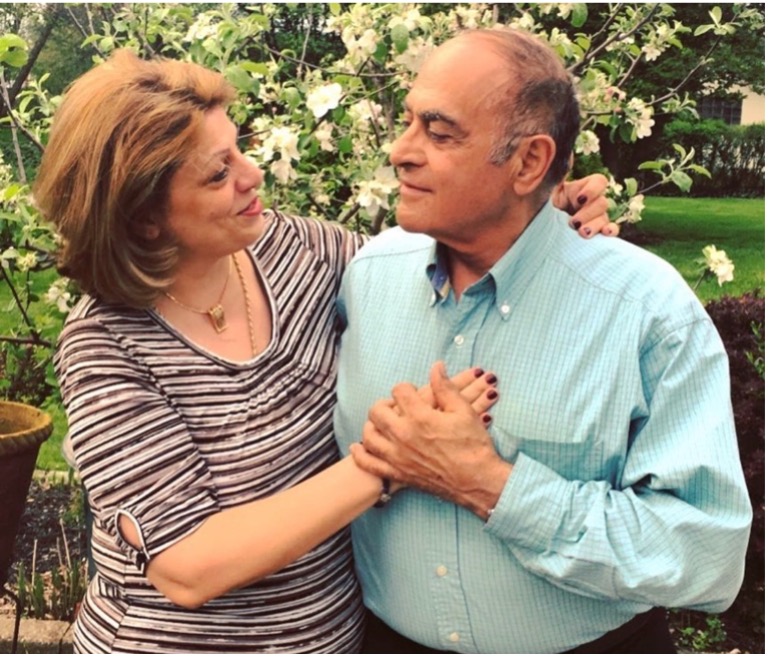
It didn’t take long to realize Uncle George was far more than the man I knew at family parties.
His voice trembled on the phone – part excitement at speaking with his “favorite godson” and part frustration at the gradual decline in his health.
For the last three years, strokes and early onset Parkinson’s have taken a toll on his physical body. His soul, though, remains as vibrant as ever.
The kind, loving and remarkably intelligent man is far from defined by these challenges.
He’s chosen to be defined by living “day by day,” and staying present with family instead of letting anger or bitterness over his physical abilities take control.
Before we go any further, let’s get something out of the way – no, his name isn’t George George. As cool as that’d be, it’s not.
Born in 1943 in Golan Heights, Syria, George Shaheen immigrated to the U.S. with his parents by boat at age 13, eventually settling with his aunt in Canton, Ohio, where he’s lived ever since.
“I always wanted to be an engineer, since I was a little boy,” Uncle George said. “My parents nicknamed me ‘Brains,’ because I was much smarter than other kids my age.”
His earliest engineering memory was building a 1962 Chevy Corvair convertible using spare parts from the local junkyard. Nearly 60 years later, he gifted the car, which still runs, to his son Naseeb on his wedding day.
This passion for designing technology led him to study electrical engineering at The Ohio State University. Just a few years after graduating, he was asked to train alongside astronaut Gus Grissom, one of the original “Mercury Seven” selected by NASA in the 1960s.
Training with Grissom was an unbelievable opportunity, but his mom insisted he stay home.
To be fair, I could see how the thought of her son being launched into space wasn’t exactly appealing, especially for a mom navigating life in a new country.
When Grissom tragically died in the Apollo 1 launchpad fire in 1967, that was the end of the discussion.
Uncle George proceeded to build a successful career as an engineer. In the late 1970s, he built one of the world’s first modern electric cars – for fun. Traveling globally for miscellaneous parts, he ultimately built the car that remains in his garage today.
It was tough to go against his mom’s wishes all those years ago, and as the son of an immigrant mom from Syria, I’ve been there. Only my closest interaction with space was watching “Interstellar” and leaving a strong Letterboxd review, but that’s neither here nor there.
In Arab culture, family bonds run deep.
“When your dad called me to be your godfather, I cried,” Uncle George said. “I saw it as a responsibility to watch over you.”
This sentiment was tested early on during my open-heart surgery in May 2008, when he offered to drop everything and fly with our family to Boston Children’s Hospital.
He took the same approach raising his three children, who have returned the favor over the years. Though he’s grateful for every check-in, he can’t help but feel “like a burden” on them and his wife of 37 years.
Fixing up cars and serving as chairman of the church board used to be routine tasks to look forward to, but without assistance, those days are now gone.
With that sense of independence shifting, Uncle George has come to value the relationships in his life, and the memories tied to them, more than ever before.
Time has a funny way of doing that.
Aside from his mother-in-law who can be “a handful,” in the house, there are few things that bring him as much joy as eating kibbeh with the family. According to Uncle George, we have the best food in the world – an opinion every culture makes, but I know to be true.
Sports also remain a key outlet for connection. Listening to him describe the heartbreak of being a Cleveland sports fan, I couldn’t help but see it as foreshadowing my own life.
I never cried like he did when Rocky Colavito was traded to the Detroit Tigers, largely because at the time, I was -40 years old.
The common ground is dragging ourselves in front of the TV every Sunday to watch the Browns, because we’d be “traitors” if we rooted for another team.
Easy for him to say – he had Jim Brown.
What excites me beyond sports is identifying the values and relationships that shape my story.
To put it kindly, let’s just say the apple fell pretty far from the tree when it comes to my engineering abilities. I could only marvel at how casually he spoke about career accomplishments.
Even more impressive were the countless personal stories he told, from spending time with my dad at church, to how proud he is that his kids support each other through everything.
This conversation was oddly therapeutic, making me wonder which stories I’ll pass on to future generations. What will my legacy look like?
We’ll see, but in the meantime, I’ll take it day by day.
