
PHOENIX- In Filipino Households titles are rarely questioned. The terms “Lola”, “Tita”, “Ate”, “Nanay” are earned through generational love and not defined by blood.
Born Gloria Beriña de Salvador, known as “Lola Glo”, is my great aunt on my father’s side. The term “Lola” stands for grandmother in the Philippine home language, Tagalog.
Going down the rabbit hole of family members, Lola Glo isn’t a blood relative but her connection dates back to World War I. Lola Glo’s mother, Luning Salvador and my great grandmother, Hating Gloria Alivio-Flores became friends during childhood. Both came from wealthy backgrounds and were only children, where they would create a sisterly bond. With this sisterhood, the future generations of Flores and Salvadors would become family. My father, Julmar Tedoco considers Lola Glo his aunt and the Salvador family his blood.
Having five daughters and the matriarch of her family, the islands of the Philippines is something she will forever call home. It was a place where her childhood, adolescence and her octogenarian days would be.
Post-World War II, she was born in 1946 in San Nicolas- Nabua, Philippines. To her, growing up past the war was important in her faith and education. She practiced the catholic faith from a very young age and implemented prayer in her daily routine.
Her childhood past-times included her playing street games like “tumbang preso” called knock down the prisoner in English and “taguan” which is known as hide and seek. Her and other Filipino children gathered in the neighborhood to play these games before and after school.
Lola Glo had let me know that her life changed when she moved with her grandmother to pursue a better education. She enrolled in Colegio di Santa Isabel, which was a catholic all-girls high school. After staying and graduating from the province of Camarines Sur, she would find herself searching to get a degree in health sciences.
“When graduating, I went very far from the province. To the big city, Manila for my college edu,” she said.
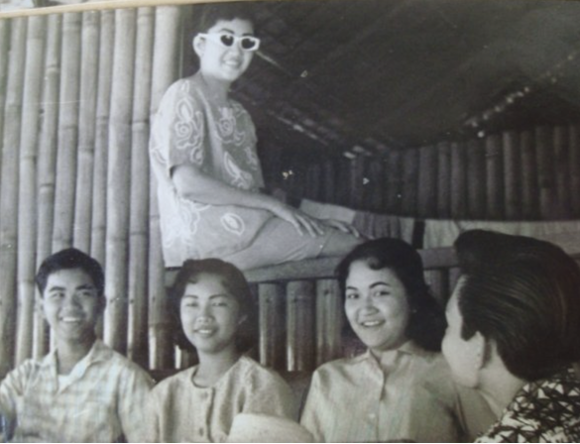
It was common that Filipinos who could afford college would go pursue a degree, which Lola Glo was able to do. She attended Philippine Women’s University with my grandmother, Maria Victoria Flores. Being surrounded by other young women helped her see the opportunities that she could achieve. During the 60s, Lola Glo and my grandmother were privileged by going to college and having the support of their families.
“There were no distractions. My parents in the province supported me and especially my grandmother, Lola Laring,” Lola Glo said.
At the Philippine Women’s University, she would find herself a socialite. Attending galas and parties with friends, she would soon meet the love of her life, who would become Lolo Boy – Boyet Limon.
Lola Glo shared that meeting Boyet Limon would alter her life again. She would begin a traditional courtship with him. Then in the next eight months, she found herself traveling to Bicol, Philippines where they would be married after Christmas.
After graduating from the university, Lola Glo built her life with Lolo Boy raising their five daughters: Joy, Mia, Angel, Love and Regina Jinggay in the Philippines. Their children would take on the “Salvador” surname with the prominence it held in the island of Luzon.
With a degree under her belt, her husband advised her to not work and he would take care of the labor. She resigned from her job and focused on raising her family.
Lola Glo leaving behind her career for love shows how traditional Philippine households functioned. She was lucky to have been pushed to go to college and pursue an education but by finding her true love, she would leave that life behind. What makes this choice hard is that she did it so willingly. She had a supportive partner who could provide which was something many women never had the option to rely on.
As Lola Glo and my grandmother, Maria Victoria Flores were cousins not by blood, they chose completely different paths after their university days. My grandmother found her freedom in a nutritionist career and Lola Glo found love, both with the support of their families.
Today, Lola Glo resides in Las Piñas City, Philippines with her daughter’s Love and Mia where she continues to practice her faith and educate family on local politics.
Lola Glo helped me understand that we have the choice to choose our family and our futures. Our lineage is not defined by ancestry solely, but by how we show up for one another in the moments that matter.
